Russian Lawmaker Predicts Bitcoin Collapse While Smart Money Rotates into Layer 2 Utility

bitcoinistPublicado a 2026-02-10Actualizado a 2026-02-10

Resumen

A Russian lawmaker, Anatoly Aksakov, predicts Bitcoin's collapse due to its lack of state backing, contrasting with strong institutional investment flows. Meanwhile, capital is rotating into Layer 2 infrastructure like Bitcoin Hyper ($HYPER), which integrates Solana Virtual Machine (SVM) to enable high-speed smart contracts on Bitcoin. The project has raised over $31.3M in its presale, attracting significant whale activity. This shift aims to address Bitcoin's scalability issues, adding utility beyond "digital gold" and supporting decentralized applications. Despite regulatory skepticism, market data indicates growing investor confidence in Bitcoin's Layer-2 evolution.

Trusted Editorial content, reviewed by leading industry experts and seasoned editors. Ad Disclosure

Quick Facts:

  • ➡️ Russian official Anatoly Aksakov predicts Bitcoin’s collapse due to lack of state backing, though market data contradicts this outlook.
  • ➡️ Bitcoin Hyper counters utility concerns by integrating the Solana Virtual Machine (SVM) to bring high-speed smart contracts to Bitcoin.
  • ➡️ Sophisticated investors have poured over $31.3M into the project’s presale, signaling a shift toward Layer 2 infrastructure.
  • ➡️ Whale wallets are actively accumulating, with recent on-chain activity showing seven-figure positioning in the protocol.

Anatoly Aksakov, Chairman of the Russian State Duma Committee on Financial Market, is at it again. He has once again targeted the world’s leading cryptocurrency, asserting that Bitcoin is ‘destined to collapse.’

As a vocal fan of the Digital Ruble, Aksakov argues that without state backing, decentralized assets simply can’t survive the long haul. It’s a bold stance, especially given Russia’s mixed signals, legalizing industrial mining for tax revenue while strictly banning crypto for buying your morning coffee.

Headline-grabbing doom predictions from central bankers are nothing new (sound familiar?), but the market isn’t flinching. Institutional flows into Bitcoin products remain strong, suggesting investors see this as protectionist noise rather than serious analysis. Yet, Aksakov accidentally hits on a real issue: utility.

If Bitcoin wants to be more than just ‘digital gold’ and survive the pressures Aksakov describes, it has to evolve beyond simple storage.

Traders aren’t fleeing; they’re building. We’re seeing a massive capital rotation into high-performance infrastructure layers. Why? Because the base layer is slow and expensive. Liquidity is aggressively hunting for speed and programmability.

That’s where Bitcoin Hyper ($HYPER) enters the picture, a project aiming to bridge Bitcoin’s ironclad security with the execution speed modern finance actually demands.

Learn more about $HYPER here.

The First SVM-Powered Bitcoin Layer 2 Redefines Scalability

The main knock against Bitcoin, that it’s too rigid for mass adoption, is being fixed.

Bitcoin Hyper ($HYPER) addresses this not by altering the base layer, but by expanding it. By integrating the Solana Virtual Machine (SVM) directly as a Bitcoin Layer 2, the network allows for sub-second finality while keeping settlement anchored to Bitcoin’s proof-of-work. In plain English: it’s fast, but it’s still Bitcoin-secure.

This opens up a massive design space for developers. Before now, building complex DeFi or gaming apps on Bitcoin was a nightmare due to Script limitations. With the SVM, Bitcoin Hyper lets devs write in Rust and deploy dApps with Solana-like speeds, thousands of transactions per second, without leaving the Bitcoin ecosystem.
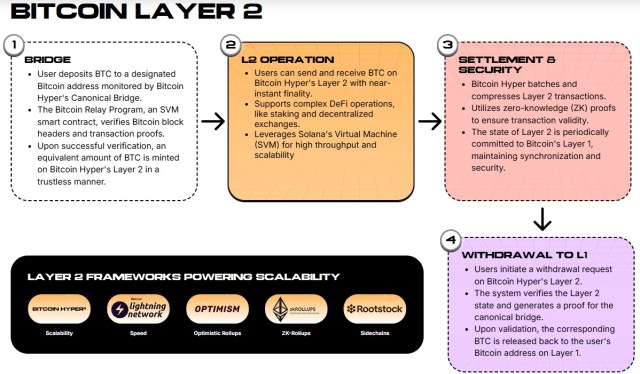
The liquidity implications are huge. A Decentralized Canonical Bridge lets holders actually use their $BTC in high-frequency trading or yield protocols instead of letting it gather dust. This utility effectively counters the ‘collapse’ narrative by turning Bitcoin from a passive rock into a programmable, active capital base.

Get your $HYPER today.

Smart Money Accumulates $31M as Whales Target Infrastructure

While regulators argue over theory, on-chain data shows where the smart money is actually going. The demand for Layer 2 infrastructure isn’t hypothetical.

According to the official presale page, Bitcoin Hyper has already raised $31.3M, signaling strong conviction from early-stage investors betting on the ‘fat protocol’ thesis applied to Bitcoin L2s.
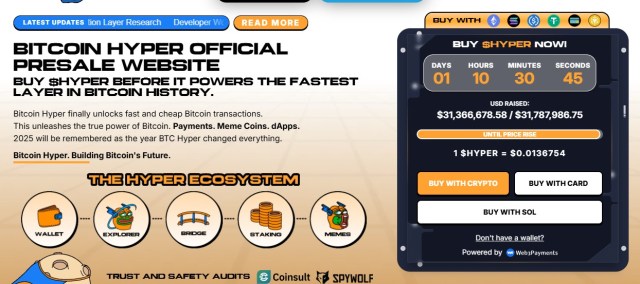
With tokens currently priced at $0.0136754, the project is attracting high-value participants hedging their Bitcoin bets. Smart money is moving.

Etherscan data confirms the trend: two high-net-worth wallets recently scooped up $1M+ worth of tokens, with the largest single buy hitting $500K. This kind of accumulation often happens right before retail catches on, large holders positioning themselves before the wider market grasps the full implications of SVM on Bitcoin.

It’s not just about price appreciation, either. The protocol offers immediate staking after the Token Generation Event (TGE). For yield-focused investors currently priced out of Ethereum’s mainnet (low APYs, high gas), this is a serious draw. By tackling the security-scalability-decentralization trilemma, this Layer 2 is shaping up to be a major liquidity sink for the next cycle.

Buy $HYPER here.

This article is for informational purposes only and does not constitute financial advice. Cryptocurrency investments are volatile and high-risk. Always conduct your own due diligence before investing.

Editorial Process for bitcoinist is centered on delivering thoroughly researched, accurate, and unbiased content. We uphold strict sourcing standards, and each page undergoes diligent review by our team of top technology experts and seasoned editors. This process ensures the integrity, relevance, and value of our content for our readers.

patrubogdan

Follow

Full Profile

Related Posts

AI Can’t Save the Market Alone, But It Can Transform It: How SUBBD Token Redefines Content Economics

Solana’s Low Fees Create Strong Competition for Base, BNB, and Polygon and Fuel SUBBD Token

Chainlink Founder Sergey Nazarov Identifies 3 Trends That Will Define the Cryptosphere as Hyper Token Soars

Bitcoin Demand Plunges Per CryptoQuant, Yet Maxi Doge Endures

Crypto Markets Catch A Breather As Outflows Begin To Slow: Analysts

SUBBD Token’s Massive Projected Impact on the Content Creation Market in 2026

Preguntas relacionadas

QWhat is Anatoly Aksakov's prediction about Bitcoin and what is his reasoning?

AAnatoly Aksakov, Chairman of the Russian State Duma Committee on Financial Market, predicts that Bitcoin is 'destined to collapse.' His reasoning is that without state backing, decentralized assets cannot survive in the long term.

QHow does Bitcoin Hyper aim to address Bitcoin's limitations?

ABitcoin Hyper ($HYPER) aims to address Bitcoin's limitations by integrating the Solana Virtual Machine (SVM) as a Bitcoin Layer 2. This allows for sub-second transaction finality and high-speed smart contracts while keeping settlement secured by Bitcoin's proof-of-work, thus adding programmability and scalability.

QWhat evidence from the market contradicts Aksakov's bearish outlook on Bitcoin?

AMarket data contradicts Aksakov's outlook, showing strong institutional flows into Bitcoin products. Furthermore, sophisticated investors have poured over $31.3 million into the Bitcoin Hyper presale, indicating a shift of capital into Bitcoin Layer 2 infrastructure rather than a flight from Bitcoin itself.

QWhat significant on-chain activity is mentioned regarding the Bitcoin Hyper token ($HYPER)?

ASignificant on-chain activity shows that high-net-worth 'whale' wallets are actively accumulating $HYPER tokens. Recent data indicates two wallets made seven-figure purchases, with the largest single buy hitting $500,000.

QWhat utility does the Bitcoin Hyper Layer 2 provide for Bitcoin holders?

ABitcoin Hyper provides utility for Bitcoin holders through a Decentralized Canonical Bridge. This allows holders to use their $BTC in high-frequency trading and yield-generating protocols on the Layer 2, transforming Bitcoin from a passive store of value into an active, programmable capital base.

Lecturas Relacionadas

Shrinking Salaries, Higher Barriers, Restricted Identities: Is Web3 Still Worth It in 2026?

"Salary Cuts, Higher Barriers, and Identity Constraints: Is Web3 Still Worth It in 2026?" Based on TT3 Labs' operational data from Q4 2025 to February 1, 2026, this report analyzes the shifting Web3 job market, particularly for Chinese-speaking candidates. Key findings indicate a significant influx of talent from traditional Web2 companies, driven by layoffs and industry restructuring. However, entry barriers have risen sharply. Even early-stage startups now often require bachelor's degrees or higher, with over 3% specifying preferences for top universities. The "big company halo" from firms like Alibaba has diminished in value compared to direct Web3 experience. Top centralized exchanges (CEXs), the largest employers, overwhelmingly prefer candidates with at least two years of industry-specific know-how over generalist tech experts from Web2, creating a high soft barrier for newcomers. This has led to a pragmatic, albeit exploitative, trend of experienced professionals taking low-paid or volunteer roles in small projects to gain crucial blockchain experience. The report highlights a major mismatch between employer needs and candidate expectations. While CEXs dominate hiring, they primarily seek talent for financial tech and risk control, not the decentralized ethos often associated with Web3. Furthermore, a phenomenon of "title compression" is observed, where managers from Web2 often accept senior individual contributor roles in Web3 due to flatter organizational structures and smaller team sizes. Job stability is low, with the average tenure in a Web3 role being just 8.6 months. Salaries are consolidating. The mainstream monthly salary on TT3's platform is between $3,000-$5,000 USD, paid in stablecoins, which is becoming a normalized practice. High salaries above $8,000 are reserved for a few core protocol or business development roles. The report notes that the era of high pay for everyone in Web3 is over. A growing challenge is "identity anxiety." Regulatory tightening in hubs like Singapore has caused visa issues, forcing companies and talent to migrate again. Consequently, more employers are adding location and nationality preferences to job postings, favoring candidates in Southeast Asia or those without certain geopolitical constraints. This is accelerating a geographic shift, with Southeast Asian IP addresses becoming more active on the platform. In conclusion, the Web3 job market in early 2026 is experiencing a painful return to normalcy. The promise of easy wealth has faded, replaced by higher barriers, more realistic salaries, and complex identity and regulatory challenges. Success now depends more on genuine belief and specialized skills than on hype.

marsbitHace 14 min(s)

Shrinking Salaries, Higher Barriers, Restricted Identities: Is Web3 Still Worth It in 2026?

marsbitHace 14 min(s)

Trading

Spot
Futuros

Artículos destacados

Cómo comprar LAYER

¡Bienvenido a HTX.com! Hemos hecho que comprar Solayer (LAYER) sea simple y conveniente. Sigue nuestra guía paso a paso para iniciar tu viaje de criptos.Paso 1: crea tu cuenta HTXUtiliza tu correo electrónico o número de teléfono para registrarte y obtener una cuenta gratuita en HTX. Experimenta un proceso de registro sin complicaciones y desbloquea todas las funciones.Obtener mi cuentaPaso 2: ve a Comprar cripto y elige tu método de pagoTarjeta de crédito/débito: usa tu Visa o Mastercard para comprar Solayer (LAYER) al instante.Saldo: utiliza fondos del saldo de tu cuenta HTX para tradear sin problemas.Terceros: hemos agregado métodos de pago populares como Google Pay y Apple Pay para mejorar la comodidad.P2P: tradear directamente con otros usuarios en HTX.Over-the-Counter (OTC): ofrecemos servicios personalizados y tipos de cambio competitivos para los traders.Paso 3: guarda tu Solayer (LAYER)Después de comprar tu Solayer (LAYER), guárdalo en tu cuenta HTX. Alternativamente, puedes enviarlo a otro lugar mediante transferencia blockchain o utilizarlo para tradear otras criptomonedas.Paso 4: tradear Solayer (LAYER)Tradear fácilmente con Solayer (LAYER) en HTX's mercado spot. Simplemente accede a tu cuenta, selecciona tu par de trading, ejecuta tus trades y monitorea en tiempo real. Ofrecemos una experiencia fácil de usar tanto para principiantes como para traders experimentados.

180 Vistas totalesPublicado en 2025.02.11Actualizado en 2025.03.21

Discusiones

Bienvenido a la comunidad de HTX. Aquí puedes mantenerte informado sobre los últimos desarrollos de la plataforma y acceder a análisis profesionales del mercado. A continuación se presentan las opiniones de los usuarios sobre el precio de LAYER (LAYER).

活动图片